Custom Software Development Company for UK Businesses
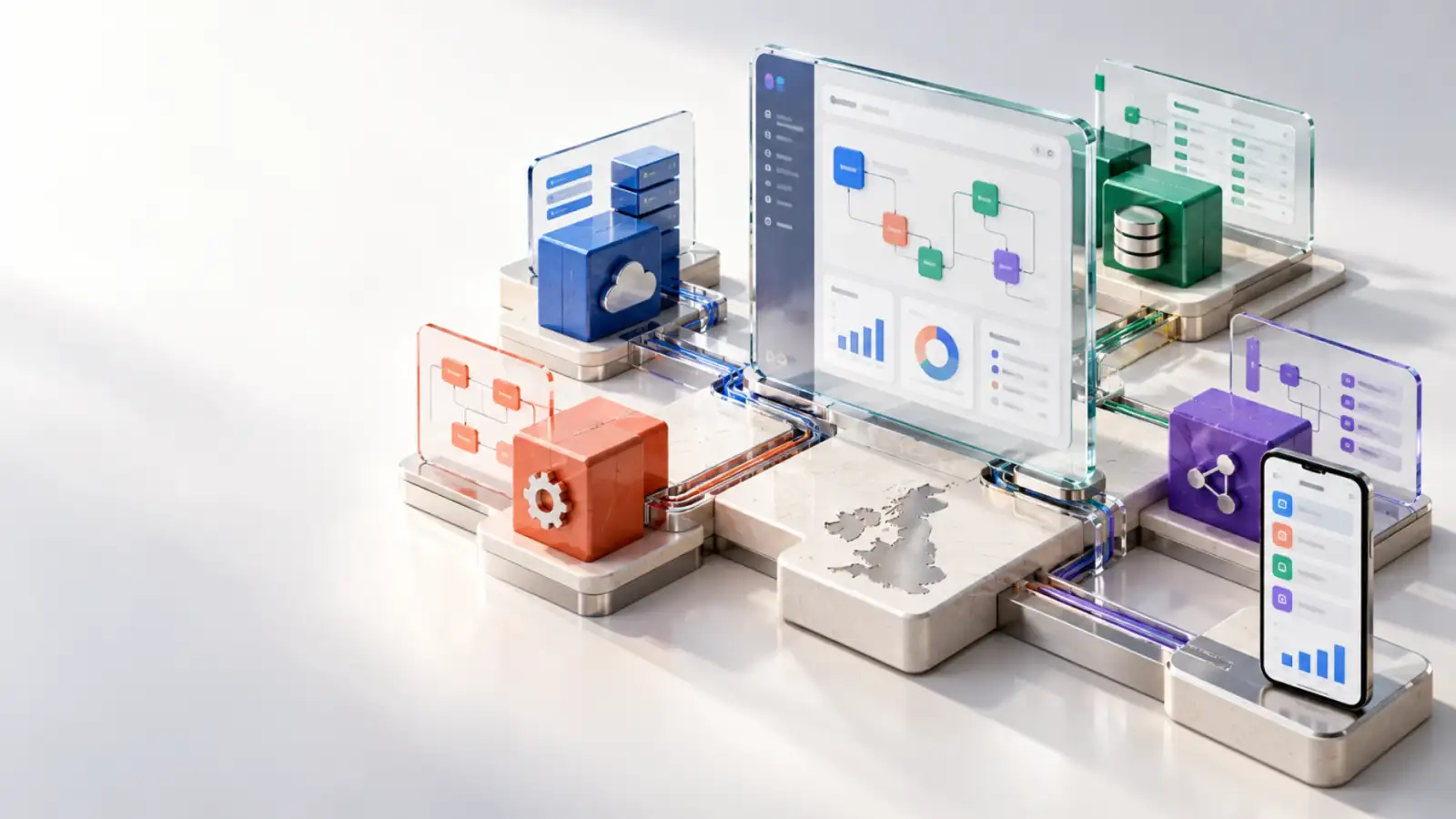
We design and build bespoke software for UK start-ups, SMEs and enterprises: web applications, internal systems, client portals and SaaS products shaped around how your organisation works. Discovery, UX, engineering and support come from one accountable team.
Off-the-shelf tools work until your processes stop fitting them. Influxive builds custom software for UK businesses, including web applications, internal systems, client portals and SaaS products around how your organisation actually operates. Our bespoke software developers cover discovery, UX, architecture, development and support in one team, so the software you commission is secure, documented and owned by you.
As a bespoke software development company serving UK organisations, we work with start-ups validating a first product, SMEs replacing spreadsheets and disconnected tools, scale-ups whose systems are straining under growth, and enterprises modernising legacy applications. Some need a complete product team; others need specialist developers alongside their own. Clients across the UK include organisations in London, Manchester, Birmingham, Leeds, Glasgow, Edinburgh, Bristol and Cardiff.
Start-ups and founders
An MVP scoped to test demand, built on foundations that can scale later.
Growing SMEs
Spreadsheets and manual processes replaced with one system your whole team uses.
Scale-ups under pressure
Architecture and processes reworked before growth breaks them.
Enterprise organisations
Phased legacy modernisation planned around operational continuity.
Regulated sectors
Access control and audit trails built in.
Teams with in-house developers
Extra engineering, architecture or UX capacity working inside your existing process and tools.
When software stops fitting
Why Businesses Commission Bespoke Software
Businesses commission bespoke software to launch products, improve operations or replace systems they have outgrown. They reach that point when workarounds cost more than a solution: staff re-keying data, licences multiplying, or a legacy system only one person understands. These are the moments UK businesses start comparing software development agencies in the UK and asking whether bespoke pays off.
Spreadsheets Running Critical Processes
Shared files hold pricing, scheduling or compliance data with inconsistent permissions, approvals and change tracking.
Too Many Tools, None Connected
Separate SaaS subscriptions each solve part of the job while staff copy data between them.
Per-User Licence Costs
Subscription fees rise with every new hire, for features most of your team never uses.
Legacy Systems Nobody Dares Change
Ageing applications run core operations, but outdated code, missing documentation and departed developers make every change risky.
Processes Bent Around Generic Software
Teams adapt how they work to fit a packaged product, adding manual steps, side spreadsheets and approval emails the software cannot handle.
A Product Built Without Validation
Months spent building features before testing whether customers wanted them or would pay for them.
Security Added as an Afterthought
Access controls, encryption and logging bolted on late, leaving gaps auditors notice.
Locked Into One Supplier
Code, hosting or data controlled by a previous agency, so switching developers becomes costly and difficult.
Data You Cannot Use
Information trapped in separate systems, so reporting relies on manual exports and guesswork.
Software development services
UK Custom Software Development Services
Our software development services in the UK cover the full cycle, from discovery and UX design to architecture, development, integration and long-term support. We build business software, web and mobile applications, client portals, workflow automation and SaaS products, and modernise legacy systems that still run key operations. Each service can be commissioned on its own or as one end-to-end engagement.
Business Process AutomationClient Portal DevelopmentSaaS Development
Layer 3
Systems
How your software connects to existing systems
Legacy System ModernisationAPI and Systems IntegrationCloud Migration
Layer 4
Operations
Keeping it fast and reliable
Performance OptimisationMaintenance and Support
Software projects across all four UK nations
Bespoke Software Development Across UK Regions
UK clients work with us remotely. Each region has its own industry mix, so the software we build reflects local sectors and regulation.
Region 01 of 10
London and South East
Financial services, professional firms and start-ups create demand for secure, scalable software delivered quickly.
London
London
London organisations often need software that meets strict client and regulatory expectations from the first release. We build client portals, internal platforms and SaaS products for financial and legal firms, with role-based access and audit trails, and help funded start-ups turn an MVP into a product that can scale.
Professional services
SaaS
Client portals
Also supporting
Reading
Oxford
Cambridge
Brighton
Southampton
All locations we support
London
Reading
Oxford
Cambridge
Brighton
Southampton
Manchester
Liverpool
Birmingham
Nottingham
Leicester
Coventry
Leeds
Sheffield
Newcastle
Bristol
Truro
Glasgow
Edinburgh
Cardiff
Swansea
Belfast
Derry / Londonderry
Lisburn
Bermuda
Hamilton
Gibraltar
Cayman Islands
Isle of Man
Jersey
Guernsey
Security and compliance
Building Secure Software for UK Data Rules
Security decisions are cheapest at the design stage. Before development starts, we agree what data the software will hold, who can see it, where it is hosted and how long it is kept. That shapes role-based access, encryption in transit and at rest, audit logging and backup arrangements. Code is reviewed and tested against common vulnerabilities such as the OWASP Top 10, and we recommend independent penetration testing before launch for sensitive systems. UK organisations also need software that supports their legal duties. Under UK GDPR, that means data minimisation, consent records where applicable and the ability to handle subject access and deletion requests. Public-facing services should meet WCAG accessibility standards, and many clients ask us to support Cyber Essentials or ISO 27001 controls.
This is technical implementation guidance, not legal advice. Please confirm your data protection and regulatory obligations with a qualified adviser.
Data protection controls
Cyber Essentials
Role-based access control
Data encryption
OWASP security testing
Audit trail logging
UK hosting options
WCAG 2.2 accessibility
Backup and disaster recovery
Penetration testing
Integration and architecture decisions
Connecting Bespoke Software to Existing Systems
Custom software rarely works alone. It needs to read from and write to the finance, HR, CRM, identity and legacy systems your teams already rely on. We design each connection around which system owns the data, how often it changes and what should happen when a connection fails.
Application
Users · Workflows · Records · Rules · Reports
ERP ⇄ Application
REST or middleware
Application sends
Transactions
Approval outcomes
Timesheets
Application receives
Master data
Stock positions
Price lists
Source of truth: Ownership agreed for each data type
Common UK platforms: Dynamics 365, NetSuite, SAP, Sage X3
How each connection is designed
We prefer documented APIs and webhooks, use middleware where several systems share data, and bridge legacy databases only when necessary. Each connection includes retries and alerts.
01
API-first design
Clean, versioned APIs so future apps and partners can connect easily.
02
Record ownership
One system named as the master for each data type, agreed before development begins.
03
Failure handling
Queues, retries and alerts to support recovery from supplier outages.
04
Observability
Logs, dashboards and health checks showing each integration’s status at a glance.
05
Documentation
API specifications and data maps handed over, ready for any future developer.
Our delivery process
From First Workshop to Working Software
Custom software carries more uncertainty than buying a product, so we reduce it in stages. Each phase ends with something you can review, test or approve before investing further.
01Stages 1–3
Explore
Understand the problem, users and existing systems before proposing any solution.
01
Stakeholder and process workshops
Current workflows, pain points and goals mapped together.
02
User research and system audit
Interviews, existing tools and data quality reviewed.
03
Build-or-buy assessment
Off-the-shelf options checked before recommending custom development.
02Stages 4–5
Define
Agree architecture, scope and priorities, then validate the design with real users.
04Your approval
Solution architecture
Technology, hosting, costs and phased scope documented.
05Sign-off
Prototype and UX design
Clickable prototype tested with users before development.
Honest scoping
Where we advise against custom code
We compare development and running costs with suitable existing products.
Custom software where an existing product fits
Microservices for a small team
Features added without evidence anyone needs them
A full rewrite when stabilising legacy code works
Proprietary frameworks that tie you to one supplier
New technology chosen for novelty, not need
If an existing product or simple integration solves it, we say so.
03Stages 6–9
Build
Two-week sprints, with working software demonstrated and tested at every stage.
06
Sprint-based development
Prioritised features delivered every two weeks.
07
Integration and data migration
Connected, reconciled and tested.
08
Security and performance testing
Vulnerability scans and load tests.
09
User acceptance testing
Your team tests real scenarios.
04Stages 10–12
Launch and support
Release safely, then improve using real usage data.
10
Controlled release
Phased rollout with a tested rollback plan.
11
Hypercare period
Close monitoring and rapid fixes after go-live.
12
Ongoing product development
Roadmap prioritised from feedback and usage analytics.
Working with our team
How We Work With UK Teams Throughout Your Software Project
Our custom software developers are based in New Delhi NCR, India, four and a half to five and a half hours ahead of the UK, so your morning overlaps with our working day. One delivery lead coordinates design and engineering and stays accountable throughout.
During your project
Remote delivery with clear accountability
Sprint demonstrations
Working features shown every sprint, not slide decks.
Written updates
Progress, risks and decisions needed, shared in one channel.
Issue escalation
A defined route beyond the delivery lead for urgent matters.
Quality assurance
Automated, manual and acceptance testing.
Documentation
Architecture, APIs and user guides handed over.
Release support
Releases scheduled outside your busiest hours, with our team monitoring closely.
Launch
After release
Owning your software
Source code, repositories and cloud accounts sit in your name, with intellectual property assigned to you under contract. We can keep developing the software or hand it over cleanly.
Ownership
Code in your own repository
Cloud accounts and licences in your name
Access reviewed and revoked when people leave
Reliability
Uptime and error monitoring
Security patches applied promptly
Dependency updates on schedule
Incident response
Evolution
Feature roadmap reviewed each quarter
Improvements based on usage data
Documentation kept current
Prioritised development backlog
What matters
With Influxive
01
Build-or-buy advice
Custom development recommended only where it outperforms existing products.
02
Product and engineering
Discovery, UX design, development and testing from one accountable team.
03
Secure delivery
Access control, code review and testing built into every sprint.
04
Your intellectual property
Source code, repositories and accounts remain yours, whoever maintains the software.
Everything you need to know before getting started.
Average response time
24 Hours
Project consultation
Free
Enterprise-ready
✓ Trusted Delivery
Cost depends on how many features you need, how many user roles and permissions are involved, and which systems the software must connect to. Data migration, security requirements, whether you need web, mobile or both, and the level of ongoing support also affect the price. A focused MVP costs considerably less than a multi-system enterprise platform. We provide a fixed-scope estimate after discovery, once your requirements are confirmed.
Most projects move through discovery, UX design, development, testing and deployment. A focused MVP with core features can often launch within 9-12 weeks. A complex platform with several integrations, user types and data migration may take several months, delivered in phases. We confirm your timeline after discovery, and two-week sprints let you see working software throughout.
Look for relevant experience with software similar to yours, and ask to see a proposed technical architecture, not just a price. Check how security and testing are handled, how delivery is governed, and who you will deal with day to day. Confirm in writing that you will own the source code and accounts. Ask how communication works across time zones and what support is offered after launch. A good partner will also tell you when an existing product would serve you better.
Off-the-shelf software is built for needs many organisations share. It can be quicker to start with, but you may need to adapt your processes to it. Licensing may depend on users, usage or subscription tiers. Custom software is designed around your workflows, permissions, integrations and growth plans. We compare development and ongoing running costs with suitable existing products. Ownership and third-party licensing are agreed in the contract.
Yes. We connect custom software to CRM, ERP, finance, inventory, HR, identity and single sign-on, payment, analytics and other operational platforms. We use documented APIs and webhooks where they are available, middleware where several systems share data, and carefully designed bridges for older databases. For each type of data, we agree which system is the master record, and we build monitoring and error handling into every connection.
Yes. We start with a technical assessment of the existing code, infrastructure and data quality, then map every dependency, integration and business rule the system supports. Where possible, we replace it in phases, module by module, with old and new running side by side, so daily operations continue during the change. Data migration is rehearsed and reconciled before cutover, and each phase is tested against real scenarios. Sometimes stabilising and extending the current system is the better option, and we will say so.
Under our standard terms, the source code and intellectual property for software we build for you are assigned to you once the agreed payments are made. Repositories, cloud accounts and documentation sit in your name. Third-party components, such as open-source libraries or licensed services, stay under their own licences, and we list these at handover.
We plan security during discovery and design, agreeing controls such as role-based access, encryption, audit logging and secure code review. Reviews and testing are informed by relevant OWASP guidance, with a risk-based scope rather than treating the Top 10 as a complete assessment. We implement data minimisation, retention rules, consent records where consent is the applicable lawful basis, and support for subject access requests. We document the parties’ controller and processor roles, applicable obligations and agreed implementation responsibilities in the project and data-processing agreements. We provide evidence of our controls for your Data Protection Officer or adviser and recommend independent penetration testing for sensitive systems.
Yes. Influxive is based in New Delhi NCR, India, and has no UK office. We support UK organisations fully remotely. India is four and a half to five and a half hours ahead of the UK, so we agree overlapping working hours. You get scheduled calls and sprint demonstrations, written progress updates, documented delivery, one named delivery lead and a defined escalation route for urgent issues.
Yes. After launch, we offer an agreed support arrangement that covers uptime and error monitoring, incident management and defect resolution. It also covers security patches, framework and dependency upgrades, and performance improvements. Alongside maintenance, we can continue to develop the product from a prioritised roadmap based on user feedback and usage data, so the software keeps pace with how your organisation changes.
Have a Process Software Should Handle?
Build Software That Fits How Your Organisation Works
Tell us what you need the software to do, who will use it and which systems it must connect to. We will review your requirements, check whether an existing product could do the job, and recommend a practical, phased plan.
Start Your Digital Journey
If your organization depends on digital platforms for operations, communication, and compliance readiness, it is worth discussing how those systems are structured.









 London